Khokhlosmic, Studio Art Capstone Exhibition Installation, May 2025
To end off my experience at Macalester College, I've developed a capstone project of multiple pieces across various mediums to explore my own tenuous and heritage as a Russian-American. I chose to portray my relation with my heritage through abstractions, separating Russian folk art forms like Khokhloma, Gzhel, and Zhostovo from their usual contexts and traditions as part of mirroring my own separation. The ideas of duality are explored in digital versus traditional (and even 3D) mediums, in warm versus cool color schemes, in arrangements and compositions, and of course in my own duality.
This capstone project, along with those from the twelve other graduating art majors, was shown in our cohort's exhibition show, Any Manner of Animal, in the Law Warschaw Gallery at Macalester College.
Below is my exhibition artist statement:
As a Russian-American artist, this collection of artwork has been an opportunity to explore a half of my heritage that I’ve rarely interacted with for much of my life, refracted across various mediums and interpretations. I have thought back onto the instances of Russian art I’ve been exposed to since childhood and to my time with the Macalester Russian department, and from there I have chosen to dive into three major Russian art forms as basis for this project: Khokhloma (Russian: Хохлома, pronunciation: [ho-hlam-a]), Zhostovo (Russian: Жостово, pronunciation: [zjuh-sta-va]), and Gzhel (Russian: Гжель, pronunciation: [gj-ee-yel]).
Each of these styles are traditionally found in florally-painted household objects; Khokhloma with its reds greens and golds on black-painted wooden bowls and utensils, lavish Zhostovo flowers on metal trays, and blue Gzhel ornamentation on white ceramic vessels. Red berries bunch between gold leaves, opulent petals adorn silver, and electric blue gardens populate fields of white. The illustrative flows and the reverence of nature found in these forms has driven my interest, forming a basis from which I abstract from.
The first half of this collection’s title, ‘Khokhlo-’, is in reference to the central focus of Khokhloma, with pieces branching into Zhostovo and Gzhel later. The second title half, ‘-osmic’, was formulated both from the cosmically-inspired abstractive forms I’m drawn to and from my diasporic relation with Russia. Floral patterns twist and swirl across mediums, warping across time and space as I struggle to place my connections.
In the shift away from the traditional household objects these styles typically adorn, I inherit the illustrative aspects of Russian art through my own means and interests. And as I pull apart the visual themes of Russian folk art and stretch what it means for something to be Khokhloma or Zhostovo or Gzhel, I explore the stretched limits of my own Russian experience.

Full photo of the Khokhlosmic capstone installation in the Law Warschaw Gallery, consisting of seven pieces across at least four different mediums: digital (inkjet prints), oil paint on canvas, screenprint, and ceramic mixed media sculpture.

Photo of the installation taken from the left side, with Khokhlosis closest and Fusing furthest.

Photo of the installation taken from the right side, with Fusing closest and Khokhlosis furthest.

Khokhlosmic Seas, digital (Krita), digital prints, April 2025
Photo of two Khokhlosmic Seas prints overlapping and mirroring each other, as seen in the Khokhlosmic installation.

Closeup of the top print.

Closeup of the bottom print. This print is an alternate version with less of the pinks and other colors of the original piece, Caustic Seas.

Khokhlosmic Seas, digital (Krita), April 2025
Khokhlosmic Seas timelapse. Starts from the original prismatic study assignment, to Caustic Seas (a color edit for Tennotober 2024 and Chanter Genesis), to the final Khokhlosmic Seas.

Lone Bloom, oil on canvas and photo print, December 2024
Photo of Lone Bloom overlapping a rotated print of it, as seen in the Khokhlosmic installation. The composition for Lone Bloom was originally inspired by the composition for Caustic Seas.

Closeup of the painting.

Closeup of the print.
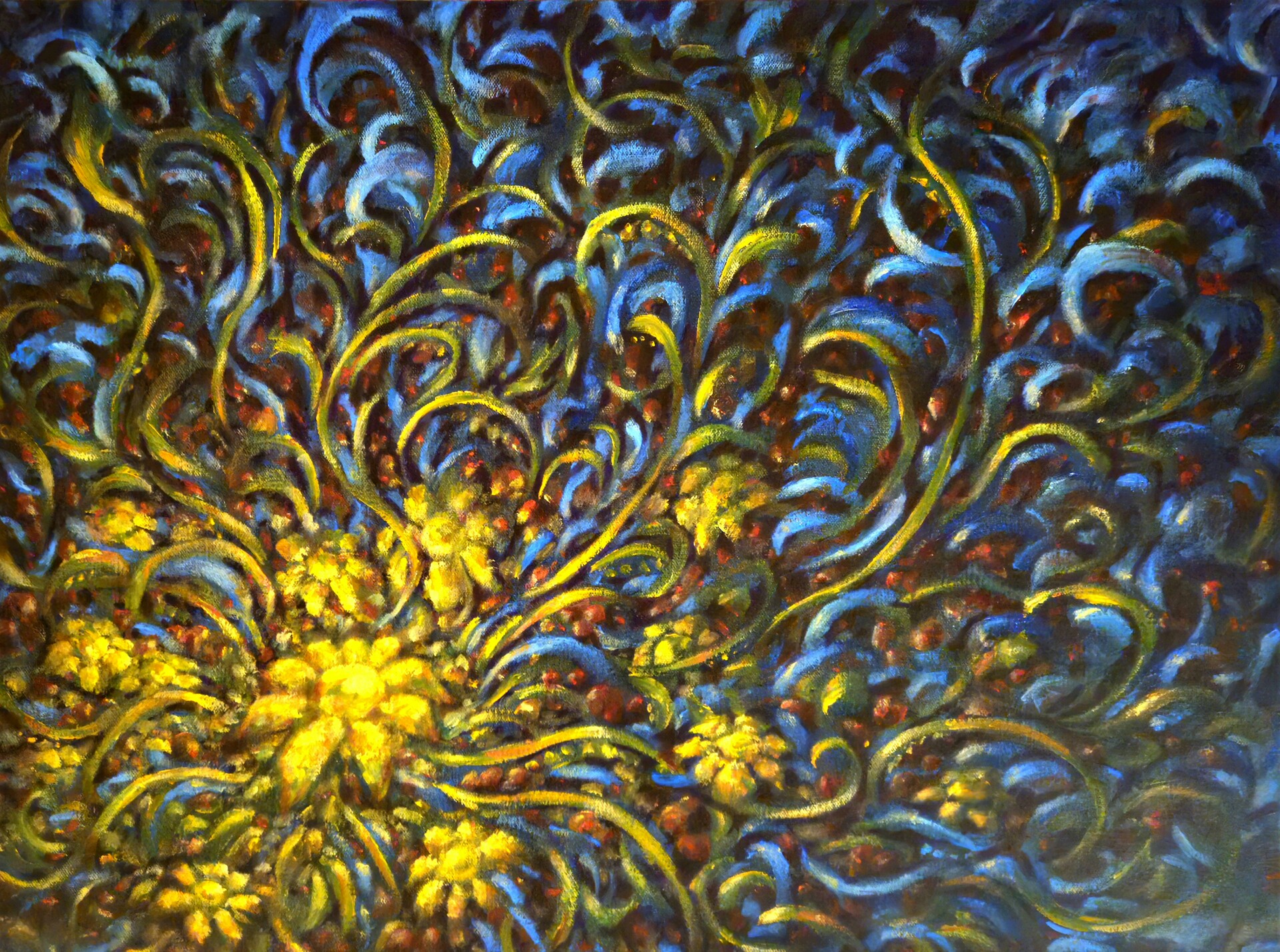
Lone Bloom, oil on canvas, photo, December 2024.
Photo scan of Lone Bloom. The piece has loose inspirations in Zhostovo and Khokhloma, with a creeping blue inspired by Gzhel.

Khokhlosmic Entanglement, digital (Krita), digital print, March 2025
Closeup photo of Khokhlosmic Entanglement as seen in the Khokhlosmic installation.

Khokhlosmic Entanglement, digital (Krita), March 2025
Originally a style exploration sketch, I returned to this drawing later in March to get it polished enough for the show.
Khokhlosmic Entanglement timelapse.

Khokhlosis, digital (Procreate), digital print, March 2025
Closeup photo of Khokhlosis, as seen in the Khokhlosmic installation. Probably a bit too close lol

Khokhlosis, digital (Procreate), March 2025.
I made this piece largely on the flight to Baltimore in the lead up to my dad's spinal surgery. Though that trip was extremely stressful, I was surprised and pleased to get this piece out of it.
Khokhlosis timelapse.

Imprint of Khokhloma, screenprint, October 2024
Closeup photo of Imprint of Khokhloma, flipped upside-down as seen in the Khokhlosmic installation.

Imprint of Khokhloma, screen print, photo scan, October 2024
Originally sketched screen prints for a printmaking class last semester, these grew on me over time and felt like good inclusions in the show for further establishing the themes of duality.

Imprint of Gzhel, screen print, October 2024
Closeup photo of Imprint of Gzhel, facing right-side-up with a string of yarn hanging from the top-right corner as seen in the Khokhlosmic installation.

Imprint of Gzhel, screenprint, photo scan, October 2024

Fusing, porcelain, yarn and wire, April 2025
Cropped photo of Fusing, focusing on the ceramic spine sculpture alone.

Zoomed out photo of Fusing, showing its yarn hanging downward as well as extending to Lone Bloom and Imprint of Gzhel.

Photo of Fusing taken from the left side.

Closeup photo of the back of Fusing, showing more of the Gzhel-like blue patterns. The rest of the installation can be seen in the background.

Closeup photo of some of the Gzhel-like patterns on the surface of Fusing. Sodium silicate induced cracks can be seen under the clear glaze while blue yarn and silver wire connects each vertebrae.

Closeup photo of the undersides of three vertebrae, a central braided yarn rope going through each along with wire. Wires wrap around three screws in the wall behind the sculpture: one at the top, the middle, and the bottom.

Closeup photo of the internal yarn and wire of Fusing.

Closeup photo of the top of Fusing, showing where it hangs from the wall. The yarn bundles around the screw to conceal it.

WIP photo of Fusing, hanging from a hallway wall for a ceramics course group critique. This version lacks the wire and extra yarn that the final form has in the exhibition.

Closeup WIP photo from the left side of Fusing during the ceramics group critique.

WIP photo of my right hand holding up Fusing, testing the stability of the yarn I had just woven through it. The yarn proved to be strong enough at the time, but for the exhibition it was advised to use wire to keep it stable for the full two weeks.

WIP photo of Fusing laying on a table after having finished weaving yarn through it for the group critique. The central braided and knotted yarn rope kept the vertebrae together while the outside looped yarn kept the vertebrae from swiveling too much.

Closeup WIP photo of Fusing on the table. In the final version an extra set of looping yarn was added to prevent it from slipping off, as would happen in this WIP.

WIP photo of Fusing just before yarn was woven through it. Multiple separate braids were made from a blue yarn in the classroom that just so happened to perfectly match the color of my sculpture.

WIP photo of Fusing while it was still wet, having just applied the Gzhel-like blue patterns as well as sodium silicate and pressure to induce surface cracks.

Closeup WIP photo of a single unfired Fusing vertebrae.

WIP photo of the first three Fusing vertebrae hand sculpted. The vertebrae are of course no anatomically accurate, as it was the impression of vertebrae that mattered as I was thinking about my dad's (then) upcoming spinal surgery.

Flier for Any Manner of Animal, the senior art exhibition my capstone was featured in. The show runs from May 2nd to May 17th 2025, and features thirteen graduating art seniors including myself.